Tuesday, June 1, 2010

Shifting Gears: From Pilgrim to Tourist....


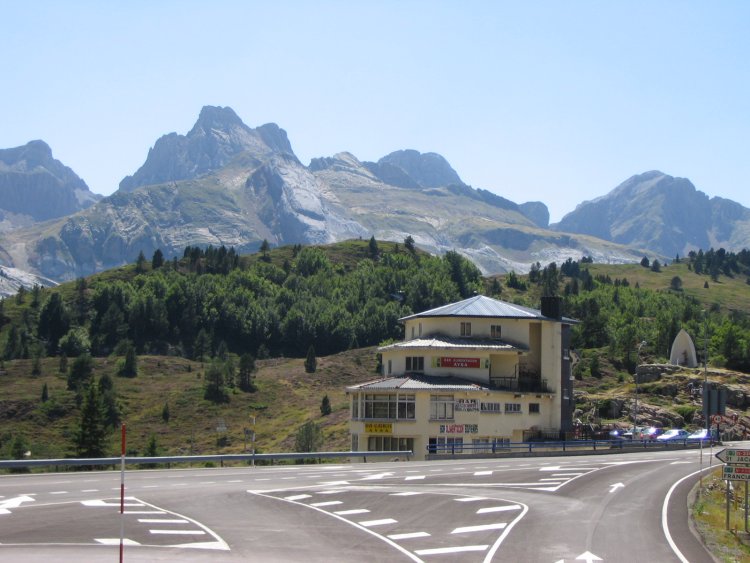
We followed the River Aragon all day to the medieval city of Jaca. In France, the Pyrenees were in front of us, beckoning. Now in Spain, they are behind us, bidding farewell.

I hate to say goodbye.

And I have to admit, crossing them was the part of the trip that most excited and terrified me. Mountains are a fierce landscape, gracious and unforgiving depending on the weather. We were lucky to cross these mountains in a fine drizzle rather than driving rain or dazzling sun.

As we push west to Pamplona, though, the mountains recede. I can barely see the snow-capped peaks over the walls of Jaca.

We have only another day of walking, from Jaca to Santa Cruz de la Seros, where we´ll spend two nights, making a day trip to the monastery of San Juan de la Pena. We´ll do that without the packs that have become like another appendage.

As much as I groaned picking up my pack every morning, I will hate to say goodbye to that too. Everything I needed was in that pack. I´ll feel naked without it.

Not surprisingly, I´m already fantasizing about the sundress I´ll buy to cover the nakedness.

I can shift from pilgrim to tourist so fast it scares me. The clothing fantasy that kept me going for the last days into Santiago this past September were a pair of Spanish jeans. I wanted something besides my trekking pants to wear.

This time I lust after a sundress -- and a pair of high-top sneakers. I must want to shed both the pants and the boots. I can´t vouch for the combination, but the fantasy is there.

So what´s the difference between pilgrim and tourist? I think it´s interesting that I long to "buy" something. Consumption marks tourism. You see it in the way people take pictures with cameras and iPhones, "bagging" another experience for their scrapbooks. Pilgrims, in contrast, are too busy walking.

You see it in the difference between tourist hotels and pilgrim hostels. Hotels are full of "stuff" to do and places to eat, each flyer vying with another to catch the eye. Pilgrim hostels are empty, tables bare and rooms waiting. The blank space work like empty canvasses, inviting impressions to emerge. Like animals along the trail, if long enough to become part of the landscape.

I see it in the difference between my tourist and pilgrim habits of mind. Believe me: I am a full-bore, world-class tourist, and I can "graze" a city like no one else, figuring out in record time what needs to be seen, when, and which route gets there most scenically. But as a pilgrim, I simply reach a city -- and sit. I can sit for hours watching.

It´s as if my pilgrim feet have taught my inner tourist to slow down. After all, the speed of consumption is far faster than the speed of simply looking.

Mary Oliver put it well:

"I look. Morning to night I am never done with looking.
Looking I mean not just standing around, but standing around,
As though with your arms open.

And thinking
Maybe something will come, some
shining coil of wind
Or a few leaves from any old tree
They are all in this too.

And now I will tell you the truth:
Everything in the world comes.

At least closer.

And cordially." ("Where does the Temple Begin, Where Does It End?")

I hate to leave this kind of looking behind.

Monday, May 31, 2010

The Road Less Traveled....


...and the Chemin d´Arles is. Maybe it´s the time of year, maybe it´s distance from Santiago -- still some 800 kms away!, maybe it´s that Santiago himself simply is not the hero for the French that he is for the Spanish. But this chunk of the trail is definitely a road less traveled.

First, I noticed what´s not there. For a traveler whose first experience of the Camino was popular Camino Frances, I missed the ever-present, always open bistros along the way. In September Lisa and I came to take for granted that perfect cafe con leche about two hours into the day´s walk in a picturesque village right by the trail. Often people we´d met along the way were already there, lifting a steamy cup in greeting.

Here, that´s not been the case. Picturesque villages abound, but nothing is open.

I missed the other pilgrims, whose encouragement I needed more than I knew. A smile and a ¨Buen Camino" were worth about 400 mgs of Ibuprofen.

Here, we see few other pilgrims. Ten days into the walk, I could count the number of fellow travelers on both hands.

I missed the sense that we´re getting somewhere, and that "somewhere" is what this route is all about: Santiago de Compostela. And even if I wasn´t wedded to seeing the saint´s relics, Santiago represented a destination. We knew when we got there, we had accomplished something.

Here, that sense of having "arrived" is more elusive. We´ll get to Pamplona, where Lisa and I set out from in September. But Santiago will still be over 500 kms away.

So, yes: first, I first notice what´s not there, what´s absent. And then I notice what is there, what´s present.

Precisely because the trail is not so well-supported, we´ve had to think ahead and we discover a kind of self-reliance I hadn´t quite noticed in the first trek. We carry food -- and we share it. On a rough stretch as we climbed the Col de Somport, a high pass in the Pyrenees that would take us into Spain, we split a milk chocolate bar. It had been purchased long ago in some hotter, drier part of the trail, and it had melted and cooled into weird and wonderful shape. But it tasted glorious -- and gave us the push we needed to summit.

And then there was Barran, which we reached in the middle of a hot Saturday afternoon, in need of water. The only place open was Coiffure Bea, a hair stylist, and Bea herself served us instant coffee -- with sugar! -- and filled our water bottles. We sat on the street and toasted her -- Santiago in drag and with hennaed hair.

Precisely because there are so few other pilgrims around, we have gotten to know our hospitallers and innkeepers better. We talk a lot about hospitality, where we find it -- and where we don´t. We know what counts as good hospitality, how important it is, and how it manifests in the first minutes of an encounter. We resolve to practice it better when we come home. We remember fondly Nicolas, the initially reticent innkeeper in L´Urbe St. Christau, who kept telling us ¨"I am not a restaurant I am not a restaurant," but proceeded to ply us with beers and fine wines throughout the afternoon. That night Nicolas turned out a first-class meal, before we discovered he was a highly regarded pastry chef and spent winters rolling around the countryside teaching people his craft.

Finally, in absence of a destination like Santiago, we follow markers along the way. We walked up the Aspe River into the French Pyrenees; we descend into Spain along the Aragon River. Rapids and waterfalls release a lot of positive ions into the air -- and we´ve been drinking them all in. I watch the mountains, as they advance and recede. Their brooding presence blesses this journey.

I noticed first the absences -- of support services, of other pilgrims, of destination, but it was into that very vacuum that something else spilled, luminous, perhaps even more mysterious.

Sunday, May 2, 2010

Getting Ready to Go Again: The Camino, Part II


There are two seasons for a pilgrim: walking -- and dreaming about it. I'm in the dreaming phase, which may be as delicious as actually walking. A colleague confessed to envy. If he were the one leaving, I'd be envious too.

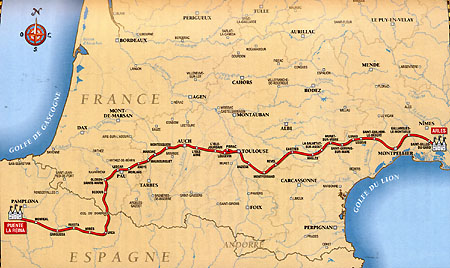
I roll on my tongue the names of the towns we'll pass through: Toulouse, Gimont, Auch, Oleron Ste. Marie, Cette Eygun, Jaca, Santa Cruz de la Seros, and finally Pamplona. Could any of these be as luscious as they taste?

I study Jan's Gear List, graciously supplied by one of the planners of the trip -- and compare it with a growing pile of stuff in the corner of the room. Would I be happy to shoulder these things across the Pyrenees?

With Jan, Jan's Gear, Jan's daughter and two of his friends, I leave on May 17th to walk the Camino -- again. I tell people this, and they seem surprised: "Didn't you already do that?" I explain that there are as many roads to Santiago as to Rome -- and for the same reason. Like Rome, Santiago was a pilgrim's destination. Routes to Santiago spread all over Europe like a spider's web with the city at its center.

This time we'll begin on one of the outer whorls of the web, starting in Toulouse and picking up a route known as the Chemin d'Arles. We don't have time to walk all the way to Santiago, but my friends have mapped out a route that ends where Lisa and I began our trek in September: Pamplona. In fact, we'll spend the final nights in Spain where Lisa and I started out, a pilgrim hotel on the plaza of the mysterious Virgen de la O.

I feel like I'm completing a circle I didn't even know existed -- and in a Holy Year at that.

The year 2010 ranks as a special year in the Roman calendar, and from all parts of the web, thousands of pilgrims will be making their way to Santiago. Even though we're leaving before peak season and taking a less well-traveled route, the closer we get to Santiago, the more crowded the path will be. Indeed, the press of pilgrims, dirty, sweaty, grumbly pilgrims, will mean we're on the right track.

In September, Lisa and I got lost only once -- and it was not very lost and right outside Santiago. We must have been deep into conversation, because it took a while before I realized that no one else was around us. We were walking alone -- and that was the signal we were on the wrong track. In fact, we'd gotten lost in some park being prepared for a papal visit in 2010, so we weren't far off the beaten path. But there were only construction workers around us. Not pilgrims.

The workers helped us get back on track. Within a few hours we were in Santiago, waiting in line with a crowd of tired, happy pilgrims to get our credentials. We were surrounded -- no, swarmed! -- by pilgrims. From our various starting points, we'd made it to our common destination.

I was reminded of the metaphor one of the Desert Fathers, Dorotheos of Gaza, used:

"Suppose we were to take a compass and insert the point and draw the outline of a circle. Let us suppose that this circle is the world and that God himself is the center: the straight lines drawn from the circumference to the center are the lives of human beings....Let us assume for the sake of the analogy that to move toward God, then, human beings move from the circumference along the various radii of the circle to the center. But at the same time, the closer they are to God, the closer they become to one another; and the closer they are to one another, the closer they become to God."

The dear Dorotheos must have been a frustrated mathematician turned eremite.

Writer Tobias Wolff condenses his insight: "If you're a Catholic, the world's a very crowded place." He telegraphs the vivid presence of a communion of saints whose lives seem more real than our own. From the great beyond, they offer direction and a love that cannot die. He testifies to the camaraderie of fellow travelers whom we meet along the way. Along the gritty streets of this world, they accompany us -- with a smile, a shrug, and a "Buen Camino!"

I can't wait to walk: bring on the crowds.

Wednesday, April 21, 2010

Burden, Unburden, Voluntary, Involuntary


On the Camino, one of the disciplines, an askesis, really, is to strip down to the minimum that you're willing to carry. How many shirts do I NEED? How many books? Marty wrote of the little "shrines" we left of things we decided that we would carry no longer. We wouldn't just toss the stuff--we'd leave it carefully stacked, imagining another pilgrim might want it.

On immersion, a different kind of stripping down goes on. We try to reach a kind of understanding of those we meet that reaches across cultures, so we try to relativize our own cultural stuff--do I NEED American TV? DO I NEED a nice steak with a decent California Zinfandel, or can I experience pupusas with an openness to their own delights? Tourists take in the superficial delights of other cultures in limited doses, while immersers dive in. Culture, of course, cuts deeper than entertainment and food, but the idea is the same--we strip down closer to the common humanity that we share, discovering different ways to approach life's challenges and opportunities. We discover that the basics are available wherever we go, and that some of what we thought was essential to happiness is merely auxiliary, and we gain, perhaps, a sadness and outrage when the essentials we have in plenitude are denied others for no reason other than greed.

Returning can be jarring, because we suddenly become aware of the burden of our excesses--if I only NEED three shirts, why do I have 20? Why am I burdened with storing them, choosing a shirt every day, with wanting new ones? Simple living comes to be seen as a freedom, not a deprivation, though, 'tis true, if I wore only one of three shirts, it's possible my students and colleagues would take note, and not in an approving way. One advantage of religious habits is that you can't tell whether the wearer has 19 more, or only 1 or 2. And there's little point in having 20, since they're essentially identical.

Returning jars when we see the excessive plenitude--why an entire grocery store aisle of pet food when people are hungry? Do cats really NEED a choice of flavors of food? Do we really NEED to cosset housecats so? (Dogs, well, that's another story...)

When I returned, I moved into a house, the first I've ever owned (co-owned, in this case.) My sense of being feral is curtailed by having an address that is "mine" in a way that an apartment or studio never really is. I have painted, cleaned, replaced toilet workings, swept, raked, mopped, chipped old paint. The house is a form of security--I realized that unless I had some major investment, I would never have the option to retire. And if I become seriously ill, I would be purely at the mercy of the state. A house for me represents, (if the market rebounds,) a kind of paradoxical freedom to be able to take care of myself should I need to. It roots me to one place, but enables independence.

Then we were robbed. My housemate's computer was taken--a serious machine because it's a primary workstation. Among other things taken were my late mother's wedding band, and a ring she'd had made from her first engagement ring. Neither especially valuable--we're not an "estate jewelry" kind of family. We've been broke for generations! But they were hers and they're gone. We have a lead to the burglar, but the Oakland police are disinclined to investigate--they have more important crimes to track, and we don't live in the kind of neighborhood where the police are especially attentive. If we were wealthy, the police would protect our belongings, but since we're not, burglary is tolerated where we live.

What do we carry, and what do we leave behind? I seem to be carrying a house now, a serious burden, but perhaps a form of freedom, not unlike the freedom of carrying my netbook across Spain. It's not a burden I ever anticipated would be possible for me--without my co-owner, it still wouldn't be.

The burglary reminds me that I can be stripped involuntarily of my stuff, without recourse. In the end, of course, we leave everything behind except love. But still--my mother's rings. I was willing to carry those, despite their minimal value. Now I don't have to. And I'm sorry about that.

Thursday, April 15, 2010

The Dog Days of Pilgrimage....


On Tuesday night, at the invitation of the Graduate Theological Union's Women's Studies in Religion program, Lisa and I were invited to talk about our grant. I had no idea what to look for.

We didn't know what our audience would be like: students from various degree programs, members of the larger community, colleagues? We didn't know the venue: would our wonderful slides project? We didn't know how many folks to expect -- "Oh, maybe between five and fifty."

We did know one thing: these are the "dog days." The ancient Romans used the term, "dies caniculares,"to describe those hot sultry days of mid-summer, when fall's cooler mornings seem far away and spring is an all-too distant splash of green. During the "dog days," the dogs languish. Forget frolicking; mere panting takes too much work. Even the angels sleep.

Tuesday is the "dog day" of the week: the blush of a new week has worn off -- and you can't find your way to weekend. More enervating, it's the twelfth week of the semester here, and the end of the semester seems three weeks too late. All gears grind. Even our scheduled time was a "dog day," too soon after our last class to relax and grab dinner, too late in the day for hard-ass scholarly discourse.

But as soon as the projection screen registered our first photo, I felt energized. Then, when Lisa passed the ball off to me in mid-sentence of her opening remarks, I knew we'd have fun.

"You're doing exactly what you did to me with the novel!" I responded in mock protest. She laughed wickedly.

And this is how we walked the "dog days" of the Camino, when everything ached but we were nowhere near finished with the day's walking. In mid-pilgrimage, we started a novel. One person would begin, then pass it off to the other -- in mid-sentence.

One day, during the "dog days" of a hot afternoon, we turned to Richard, a young American we'd met working at pilgrim hostel. We embellished his story, fabricated a sweetheart for him from the small hillside village where we'd met him, spun a story around her and her out-of-wedlock child from a high-school sweetheart, who'd gone off to med school in Salamanca, cut off all contact with her and the village -- and fallen in love with a fiery Nicaraguan pre-med student committed to social justice. I'd tell the story for a while -- then pass it off to Lisa just as something exciting was about to happen.

We'd pick up the threads the next afternoon, just as the "dog days" of the afternoon set in, just as the pain asserted itself, just as the day's heat focused its energies upon us. We spent literally miles wrapped up in our story. Telling a story whose ending we did not know kept us from hurting; it kept us from fighting; it kept us going. The resultant novel still has no ending -- and defies all taxonomies of genre. It probably falls somewhere between Jesuit science fiction and bodice ripper.

I could see the same tactic was going to get us through the "dog days" of this evening, the "dog days" of the semester, the "dog days" of any present and future pilgrimage.

What's in it, this magical antidote to "dog days?" There's humor, of course: the ability to laugh at anything, everything, but particularly yourselves. Then, there's imagination, but imagination rooted in reality. After all, there was a real Richard. We'd met him. His character in the novel was remarkably true to his character in the tiny village where we'd met him. Finally, there's gritty truth: we knew we had to keep walking. And we could do it grumpily -- or gracefully.

Telling stories helped us find grace.

And how does grace come?

Usually where you least expect it: we thought the pilgrimage would be more "spiritual," and we'd packed readings from the daily lectionary to contemplate while walking. But the graces we encountered came through our feet -- and our imaginations. Immersing ourselves in the fictional worlds of Bianca and Richard, worlds we had fabricated on the basis of the real, helped us face our own world more graciously.

Grace also comes with skin. Sometimes I wanted to shake her awake or hurry her along, but for me Lisa was grace with skin.

We're in a season, the Easter season, graciously given to the disciples so that their eyes get used to recognizing the Risen Christ, grace with skin in their own lives. The same skin that had been crucified was now resurrected and among them. They had a hard time recognizing it: so Jesus stuck around, appearing every once in a while as an occasional eye exercise.

It makes me aware that if I want to find grace in the world around me now, I'd better look to the people around me.

Grace with skin.

Tuesday, April 6, 2010

The Pilgrimage of the Easter Season: Where's Jesus?!


When my nieces were young, they cornered me on the couch with a book and said: "Where's Waldo?" I looked at a double-page spread of images piled on top of one another in dizzying vertical array. There were busses, cars, trucks, skyscrapers, houses, with people, cats, dogs, and birds all over the page. Where was Waldo? I was no help, because I didn't know what Waldo looked like to begin with.

I had no idea what I was looking for.

That puts me in a very similar situation to the disciples in the season after Easter. Christ is risen! He is risen indeed! But no one knows what he looks like. No one knows what they are looking for.

Mary Magdalene mistakes him for a gardener. The disciples on the road to Emmaus mistake him for a wandering rabbi. And the usual suspects who've returned to their usual pursuits -- fishing on the Sea of Tiberias -- think he's some backseat fisherman, giving orders from the safety of the shore. Nobody recognizes the risen Christ.

It's pretty clear no one has any idea what they are looking for. So these forty days between Easter and Ascension give their eyes time to adjust to life in the Resurrection Zone. Forty days -- the same as Lent. And even more important.

Jesus comes back to teach, to leave peace, to touch and be touched -- and to cook the disciples breakfast. Like the Last Supper in Holy Week, the First Breakfast is the meal of the Easter season.

More congregations ought to celebrate that!

One of my friends complained about having the post-Easter doldrums: after the drama of the Triduum, we're now in "ordinary time -- and it just seems, well, so ordinary."

Hey -- it's not ordinary time yet! In the liturgical year, this is the season of Easter, and these forty days constitute a pilgrimage every bit as important as Lent's. Along the way, we learn to recognize the resurrected Christ.

So, where is he in the midst of that dizzying vertical array of appointments, deadlines, and e-mails in our lives?

Do we even know what we're looking for? Or will he surprise us along the road, like he surprised the disciples en route to Emmaus?

Be watching.

Thursday, April 1, 2010

Rituals of Re-Entry: What Immersion Teaches Pilgrims


Entrada: this way forward. If only it were so easy! Both pilgrims and people on immersion trips wrestle with problems of re-entry. Every semester winds down, and the student returns to campus. Every road comes to an end, and the pilgrim packs up for home. What's the way forward?

Yesterday afternoon I pondered the question of re-entry with fellow pilgrims and "Camino-heads," Kathy Gower and Lin Galea. Guidebooks and websites tell the pilgrim how to prepare for journey: what gear to pack, how to train, where to stay along the way. But no one tells pilgrims how to return. The disorientation can be profound.

The conversation explained my own behavior. I suddenly understood why, immediately upon returning, I joined the American Pilgrims network (www.americanpilgrims.com). I understood how I'd been drawn to the first Bay Area meeting a thumbtack to a magnet, like everyone else in the room. I understood why were we were sitting together, watching rainshowers and sunshowers roll across the Bay.

It was as if we'd all awakened one morning speaking a language no one else could understand. It was a relief to find some other native speakers.

Seasoned leaders of immersion trips expect problems of re-entry -- and they try to prep students for them. Directors of the Casa have a final retreat focused on the way forward. Similar to the orientation retreat that opens the program, the closing retreat preps people for "disorientation." As I listened to how the final retreat worked, I realize that immersion can teach pilgrims a lot, particularly three important rituals of re-entry.

First, acknowledge the disorientation. A long-time leader of delegations talked about preparing a group of college students for re-entry after they'd gone down to Louisiana after Hurricane Katrina. The students had shoveled mud, waded through muck, scoured and scrubbed --and were heading home for the holidays. Summoning them, their leader spoke as strongly as she knew how: "You are going to hate your families for not having been there. Those feelings are real and powerful. I absolutely understand your feelings -- and it would be absolutely inappropriate and sinful to attack others as a result of them."

Her warning probably prevented a lot of bloodshed. And certainly pulled some punches that might otherwise have connected.

A piece of advice that Kathy Gower passed on months ago made new sense: "Pack for pilgrimage as if you are never coming back." For medieval pilgrims, this could be literally true: they could be killed, robbed, or felled by disease. Today those dangers have largely disappeared, but the truth remains: you don't come back. Even though you return to the same surroundings and relationships, you're not the same person. Everything needs to be recalibrated.

If pilgrims knew to expect this -- as immersants do, re-entry could be less frustrating, less confusing.

Second, think about how to give back. Not everyone has the time and money, means and sheer physical ability to do either pilgrimage or immersion. How can you share what you've learned or experienced? For Lin, this has been quite concrete: through the American Pilgrims network, she's trained to be a hospitalero, worker at a hostel. She's return this summer to work outside Sevilla at a site on the Via del Plata. Her work will directly benefit the influx of pilgrims expected to converge on Santiago in the summer of 2010, a "Holy Year" in the Roman Catholic calendar.

At the end of our delegation in Mexico City, we had a final "disorientation" session, where we committed ourselves to "action plans." In the presence of the other delegates and our leaders, we covenanted ways to be in solidarity with them back in El Norte.

A key piece of this ritualization needs to be the recognition that you can rarely ever repay the kindness and hospitality you've received. Sometimes all you can do is to "pay it forward," acting locally in appropriate ways to witness to what you've experienced.

Finally, stay in solidarity with those who've accompanied you. Casa students find ways of keeping in touch upon their return, and Director Kevin Yonkers-Talz is intentional about convening groups of Casa alums on his frequent trips to the United States. Pilgrim networks abound, drawing like magnets people who suddenly discover they speak a language they'd never bargained on learning.

Keeping company: that's what we were doing yesterday, as we watched spring rains rake the Bay. After all, three people can do things one person can't manage alone.